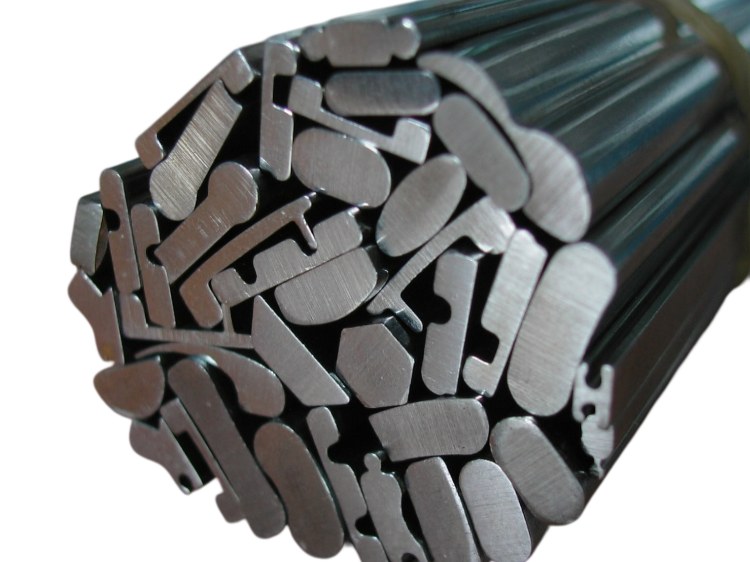
A watch band customer once wrote to complain that our wire was wrong. It was not wrong. It was drifting about 0.03 mm in thickness across the coil, which sounds like nothing until you assemble twenty links and one of them sits proud of its neighbour. You cannot polish that away. You can only scrap the batch.
Watch band work is where the ±0.02 mm number stops being a spec sheet line and starts being the whole job.
What Actually Goes Wrong on the Assembly Line
Nobody notices a tolerance until it costs them. In watch bands, three failures repeat:
- A visible step at the joint. Links are stacked and pinned; thickness variation shows up as a ridge. Polishing follows the ridge, so it survives finishing and shows in the final product.
- Loose or tight pins. Press-fit interference depends on the hole and the surrounding section being consistent. Vary the thickness and the fit varies with it.
- Shading after plating. A surface that is flat within a few microns takes an even deposit. A surface with roll marks or a slight crown takes an uneven one, and you see it as a colour shift across the band.
None of this shows up on an incoming inspection report that only checks one spot per coil. It shows up at assembly, which is the most expensive place to find it.
The Two Numbers That Decide the Part
For a band link, the control dimension is thickness. That is the one we hold to ±0.02 mm, and we hold it across the coil, not just at the head end. The second number is edge radius. Too sharp and the edge cuts the polishing wheel and leaves a burr that survives finishing. Too round and the link no longer sits tight against its neighbour. Most drawings show a radius, but plenty of them show a radius the tooling cannot actually produce at that thickness — worth a conversation before the first coil, not after.
Temper Consistency Beats Peak Hardness
Half-hard is the usual choice for links: enough strength to hold shape, still formable. The number on the certificate matters less than whether it is the same at the start of the coil and at the end. If springback drifts through the coil, the formed link geometry drifts with it, and your press operator spends the shift chasing the adjustment.
We get consistency from the process rather than the certificate: cold roll to form the section, cold draw to bring the tolerance in, bright anneal between passes, then a final reduction to the temper you asked for. Soft, half-hard and hard are all available — the point is choosing one and staying there.
Surface Is What the Buyer Sees
After polishing and plating, the wire surface is the product. We work to Ra ≤ 0.8 µm with no die marks and no handling scratches. A single scratch that crosses the band shows up after plating as a bright line, and no amount of polishing hides it, because the defect is below the surface you are polishing.
Write the Order So Nothing Gets Lost
A clean enquiry saves a week of email. Send us:
- The section drawing, with the control dimension called out (not every dimension toleranced — just the ones that matter).
- Tolerance on that dimension, and the edge radius.
- Temper: soft, half-hard or hard.
- Surface requirement, or a sample of what you accept today.
- Coil weight and inner diameter your machine takes.
- Whether the part gets welded or plated afterwards.
- Rough annual volume, so we can quote honestly instead of cautiously.
With that in hand we quote in a day, and standard sections run 20 working days from drawing approval and first-article sign-off.
The Same Story in Zippers and Key Blanks
Watch bands are not special, they are just unforgiving. Zipper elements have the same problem in a different place: thickness decides whether the elements interlock cleanly or jam on the forming tool, and the Y or X section has to be symmetrical or the chain runs to one side. Key blanks are the flatness version — if straightness wanders past about 0.5 mm per metre, the blank will not feed reliably into the cutting machine and the operator blames the machine.
All three industries buy shaped wire for the same reason: a formed part is only as good as the section that feeds it. You can see the sections and the sizes we hold on the shaped wire pages, or read our note on how to specify a custom section if you are starting from a sketch.
Send us the drawing and tell us what the part does. Our sales team will tell you what we can hold and what it costs, without the round of guessing.
Contact info@ekwire.com for more information about our shaped wire and profile wire products.