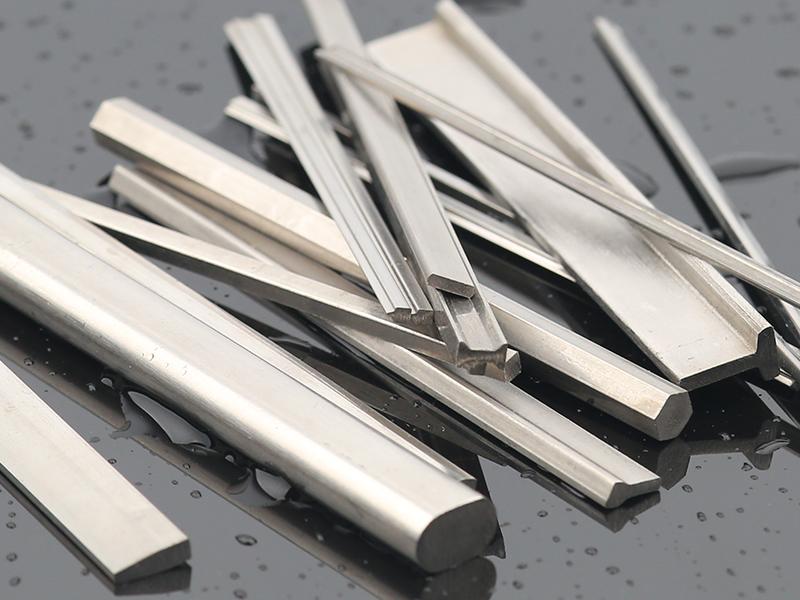
Every week someone sends us a drawing — sometimes just a photo of a sketch on graph paper — and asks: can you make this section? How close can you hold it? Fair questions. Here's how we answer them, and what you can do to get a fast, accurate quote instead of a round of emails.
Show Us the Section, Not Just the Name
People ask for "flat wire" or "shaped wire" and assume we know the rest. We don't — and that's fine. Two customers asking for "trapezoidal wire" usually need two different parts. What actually tells us everything is the drawing with the dimensions that matter marked. Not every dimension — just the one or two that decide whether the part works on your machine. For a watch band link, that's thickness. For a wedge screen profile, it's the angle and the tip radius. For a zipper element, thickness again — get it wrong by a few hundredths and the elements jam on the forming tool.
A PDF, DWG or STEP file works. So does mailing us a sample of the wire you're using now — honestly, that's often the fastest way. We'll measure it and rebuild the section from there. You can see the section families we roll and draw every week on the shaped wire page.
About That ±0.02 mm
Our standard tolerance is ±0.02 mm on the controlling dimension, and we hold it across the whole run — not just on the first coil we measure. Three things worth knowing before you write a tolerance on a drawing:
- Don't tolerance everything. If every dimension is ±0.02 mm, drawing speed drops and the price climbs. Most parts only need one or two dimensions held tight. Tell us which ones actually matter.
- Chunky sections are easier than thin, wide ones. A 2 × 3 mm flat section holds tolerance all day. A 0.3 × 12 mm blade moves around during drawing and straightening — it can be done, but expect a conversation about it.
- Say where you measure. "±0.02 mm" means nothing until you fix the gauge point — usually the widest working face. Put it on the drawing and nobody argues later.
Every new section gets a first-article report before the run continues, so you see real numbers, not promises.
Picking the Grade
If you're not sure which stainless grade you need, don't just copy your competitor. Tell us where the part lives — salt water, sweat, acid, outdoor sun — and we'll suggest something. Here's the short version of what we draw daily:
| Grade | Honest fit |
|---|---|
| 304 | The default. Good corrosion resistance, forms nicely. Zippers, key blanks, most watch parts |
| 304L | Same as 304 but low carbon — pick it if the part gets welded or annealed after forming |
| 316L | Handles sweat and salt much better. Watch bands that sit on skin, wet filtration |
| 2205 duplex | Twice the strength of 304, tough against stress corrosion. Load-bearing screen profiles |
| 2507 super duplex | Nasty environments: desalination, mining, chemicals. Costs more, worth it |
| Titanium Gr2 | Light, basically immune to corrosion, skin-safe. And yes, harder to draw |
Upgrading a grade at the drawing stage usually costs less than people expect. Downgrading after a failure costs a lot more.
Temper, Surface, Packing
Soft, half hard or hard — your forming process decides. Most automatic stamping lines want half hard: stiff enough to feed, still formable. Surface comes bright as-drawn, typically Ra ≤ 0.8 µm, ready for polishing or plating if you need it. We ship coils, spools or straightened lengths (straightness ≤ 0.5 mm per metre), packed for export with rust protection when needed.
Lead Time: Count 20 Working Days
For a section we've tooled before — or one that's clearly specified — it's 20 working days from drawing approval and sample sign-off. New tooling takes longer. So do duplex, titanium and very large coils; those get confirmed in the quote. One tip from our side: enquiries that arrive with the grade and gauge point already agreed skip most of the back-and-forth and start production days earlier.
What to Send Us
Simple checklist — nothing on it is optional, and none of it takes long:
- Drawing (PDF, DWG, STEP) or a sample
- The dimensions that matter, with the tolerance you need
- Grade — or just the working environment if you're not sure
- Temper and surface finish
- Coil, spool or straight lengths
- Rough annual quantity (it affects tooling and price more than you'd think)
Send that to our sales team — you'll hear back with feasibility and a price within 24 hours on working days. Want examples first? Look at custom shaped wire or the triangular wire we make for wedge screens.
Contact info@ekwire.com for more information about our shaped wire and profile wire products.